Sequence and Its Limit
A sequence of complex numbers is a collection of numbers \(z_1,z_2,z_3,\ldots\) in which each positive integer corresponds to exactly one complex number. Terms of a sequence may repeat.
If \(z_n=x_n+iy_n\), then each term of the sequence can be represented as a point with coordinates \((x_n,y_n)\) on the complex plane.
Consider the sequence
Its first terms are:
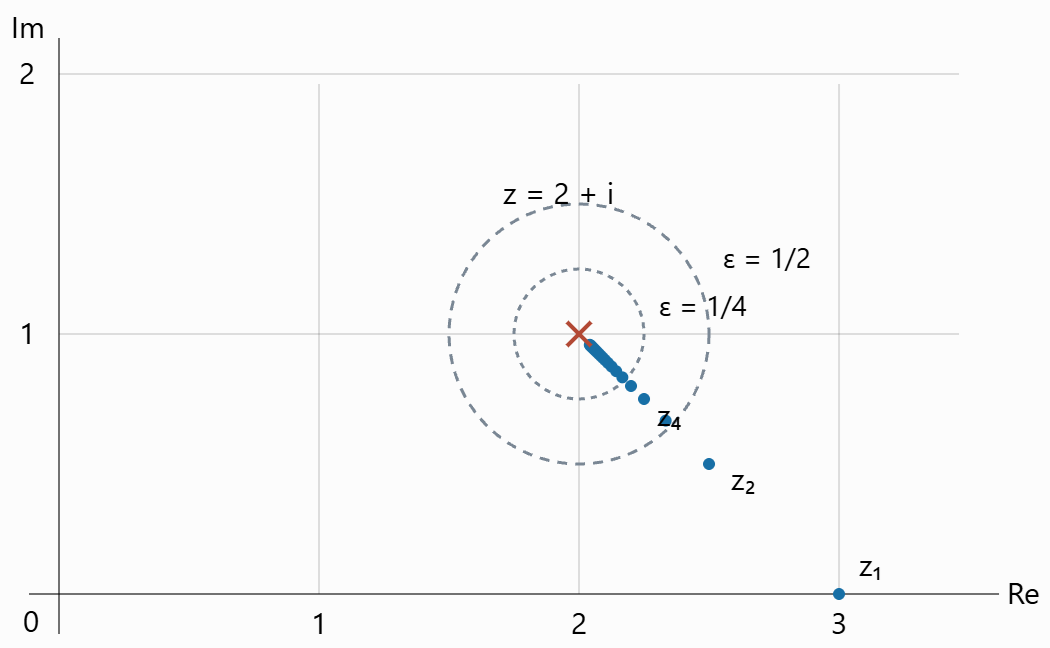
As \(n\) increases, the real part approaches \(2\), while the imaginary part approaches \(1\). Therefore, the points \(z_n\) approach the number \(2+i\).
The distance between the complex numbers \(z_n=x_n+iy_n\) and \(z=x+iy\) is measured by the modulus of their difference:
A sequence converges to \(z\) if, for every positive tolerance, the distance \(|z_n-z|\) remains smaller than that tolerance for all sufficiently large indices \(n\).
An open disk of radius \(\varepsilon\) centered at \(z\) is called an \(\varepsilon\)-neighborhood of \(z\). The inequality \(|z_n-z|<\varepsilon\) means that the term \(z_n\) lies inside this disk.
If a sequence converges, then from some index onward, all its subsequent terms lie in any such neighborhood.
In applications, the term \(z_n\) can be regarded as an approximation to the limit \(z\). The difference \(z_n-z\) is then called the approximation error, while its modulus \(|z_n-z|\) is the absolute error. The number \(\varepsilon\) specifies the maximum allowable error.
How to Achieve a Given Accuracy
The definition of a limit allows us not only to establish convergence but also to determine how large the term index must be to achieve a given accuracy. To do this, we solve the condition \(|z_n-z|<\varepsilon\) for \(n\).
Example
For the sequence
the limit is \(2+i\), and the absolute approximation error is calculated as follows.
-
Subtract the limit from the approximation:
\[ z_n-(2+i) = (2+i)+\frac{1-i}{n}-(2+i) = \frac{1-i}{n}. \] -
Take the modulus—the length of this displacement:
\[ \left|\frac{1-i}{n}\right| = \sqrt{\left(\frac1n\right)^2+\left(-\frac1n\right)^2} = \frac{\sqrt2}{n}. \]
For example, when \(n=10\), we obtain \(z_{10}=2.1+0.9i\). This number differs from the limit \(2+i\) by \(0.1\) in each coordinate, so the distance between them is \(\sqrt{0.1^2+(-0.1)^2}\approx0.1414\). This is the absolute error produced when the limit is replaced by a finite term of the sequence.
For the error to be less than \(0.01\), we need
Therefore, the required accuracy is achieved for every \(n\ge142\), so we may choose \(N=142\). The smaller the allowable error, the larger the required index. There is no need to calculate the preceding terms: the formula immediately determines the index from which the specified condition holds.
Convergence does not require every successive term to be closer to the limit than the previous one. The points may approach the limit from different directions, and their distance from it may fluctuate.
The only requirement is that all sufficiently late terms of the sequence lie in every specified neighborhood of the limit.
Componentwise Convergence
A complex sequence converges if and only if the sequences of its real and imaginary parts converge:
This follows from the inequalities
If the distance between \(z_n\) and \(z\) tends to zero, then the deviations of the real and imaginary parts also tend to zero. The converse is also true: if both coordinate errors tend to zero, then the modulus of the difference tends to zero as well.
For example, if the deviations in both coordinates are \(0.008\), then the distance is
Each coordinate error is less than \(0.01\), but the absolute error already exceeds this tolerance.
To guarantee the condition \(|z_n-z|<\varepsilon\), we can check the absolute error directly or require
Complex Iterative Process
Consider a process in which each new state is calculated using the formula
Here, \(q\) and \(c\) are constant complex numbers, and \(z_0\) is the initial state. Indexing from zero denotes the state before the first update; the meaning of convergence does not depend on the choice of the initial index.
If the sequence has a limit \(z_*\), it must satisfy the equation
For \(q\ne1\), we obtain the fixed point
A fixed point is a state that remains unchanged under the update formula. However, its existence does not yet prove that the process will reach it from a different initial state. Introduce the complex error of the current approximation:
Subtracting the equation \(z_*=qz_*+c\) from the iteration formula gives
Therefore,
When \(|q|<1\), the modulus of the error tends to zero for every initial value, so the process converges to \(z_*\).
- the modulus of \(q\) indicates the factor by which the distance to the limit changes in one step;
- when \(q\ne0\), the argument of \(q\) determines the rotation of the nonzero error vector; when \(q=0\), the process immediately reaches the fixed point \(z_*=c\).
Example of an Iterative Process
Rotation and Error Reduction
Let
The fixed point is
The initial error is:
Therefore,
At each step, the error vector rotates \(90^\circ\) counterclockwise and becomes half as long.
After ten updates, the error is less than \(0.001\), since
When to Stop the Computation
In this simple example, the fixed point can be calculated directly, so the absolute error \(|z_n-z_*|\) is also known. In more complex problems, the exact limit is often unknown, and this quantity cannot be calculated directly. Therefore, a program will often check the change between consecutive iterations—the step size:
The iteration step and the approximation error are different quantities. A small step alone does not guarantee that the current value is close to the limit.
For the process \(z_{n+1}=qz_n+c\), the relationship between the step size and the absolute error can be derived exactly:
Therefore, when \(q\ne1\),
For example, when \(q=0.99\), the absolute error is one hundred times greater than the step size. A change of \(10^{-6}\) corresponds to an error of \(10^{-4}\).
To guarantee the condition \(|z_n-z_*|<\varepsilon\), we must require
Boundedness and Convergence
A sequence is called bounded if there exists a number \(M>0\) such that
for every index \(n\). Geometrically, this means that all points of the sequence lie inside some disk centered at the origin.
Every convergent sequence is bounded. Indeed, all sufficiently late terms lie, for example, at a distance of less than one from the limit. Only finitely many terms remain, so a common sufficiently large radius can also be chosen for them.
The converse is false. Consider the sequence
It cycles through four points:
The modulus of every term is equal to one, so the sequence is bounded. However, it has no limit: the terms \(z_{4k}=1\) and \(z_{4k+2}=-1\), where \(k=1,2,\ldots\), remain at different points for arbitrarily large indices. They cannot both approach the same number.
Key Takeaways
- Convergence means that the distance to one particular complex number tends to zero.
- A complex sequence converges if and only if its real and imaginary parts converge.
- When checking accuracy, the absolute error must be considered, not only the deviations of the individual coordinates.
- The existence of a fixed point of an iterative process does not by itself prove convergence to that point.
- A small step between iterations is a reliable stopping criterion only when its relationship to the error is known.
- Every convergent sequence is bounded, but not every bounded sequence converges.